
RERA Registration Check: Five Things the Hoarding Will Not Tell You
A RERA number is not a safety certificate. Five checks to run on the registration file itself, and why 27.6 lakh buyers are delayed inside registered projects.
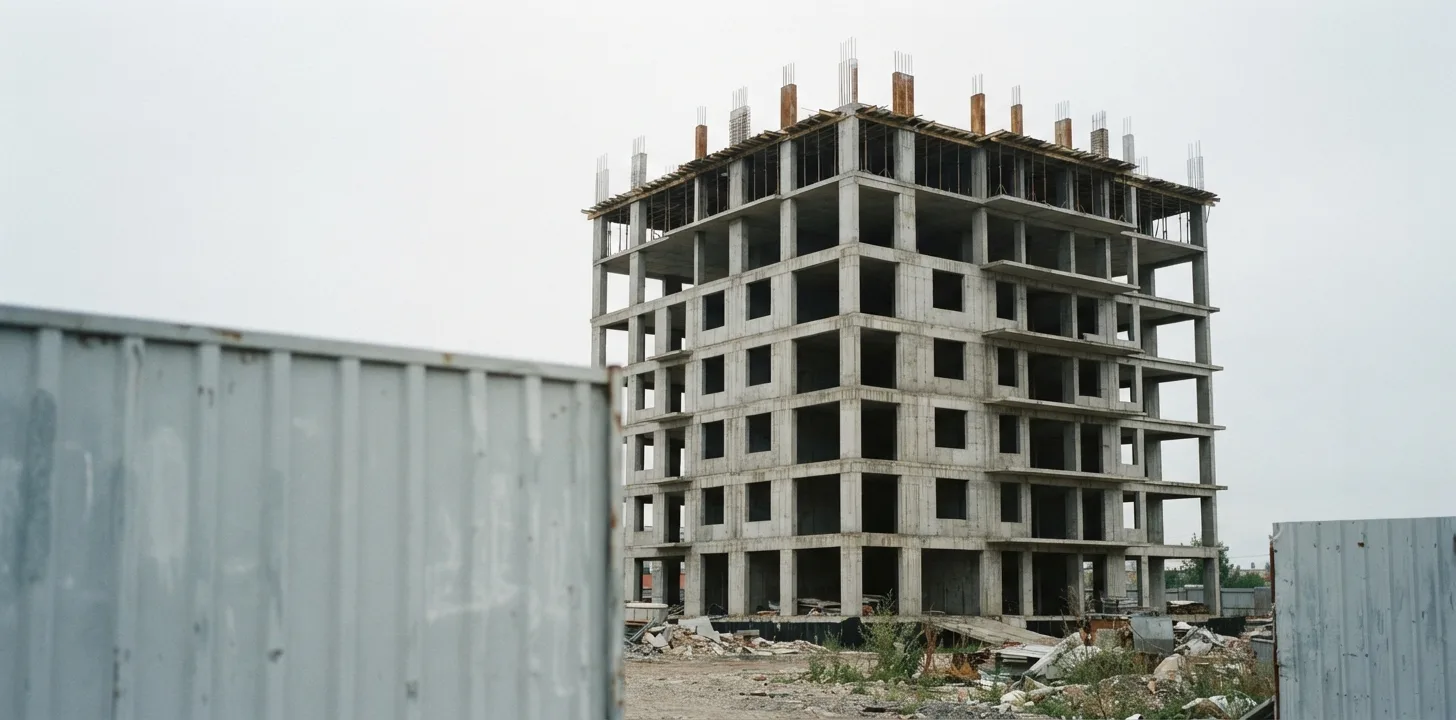
A law that works on paper, and 27.6 lakh families still waiting#
In September 2026 a homebuyers' body, the Forum For People's Collective Efforts, published a 192-page report built on the housing ministry's own RERA Tracker data as of 2 March 2026. Its finding: 27.6 lakh buyers are stuck in delayed projects that are registered under RERA, with roughly 12.44 lakh crore rupees of their money inside them. Registered. Not fly-by-night plotted schemes on the edge of town, but projects with a number, a certificate, and a listing on a government website.
Seven months earlier the Supreme Court said something blunter. Hearing a Himachal Pradesh appeal about shifting the state RERA office from Shimla to Dharamshala on 12 February 2026, Chief Justice Surya Kant said "it is high time that all the states should revisit and rethink constituting this authority", adding that apart from "facilitating builders in default, it is not doing anything else" and that it would be "better to just abolish this institution". He was talking about RERA authorities generally, not only the Himachal one. Those were oral observations in an administrative dispute, not a judgment, and they bind nobody. They still came from the sitting Chief Justice.
Which leaves the ordinary buyer somewhere awkward. The number on the hoarding is not the guarantee it looks like.
What a RERA registration actually certifies#
The Real Estate (Regulation and Development) Act, 2016 came fully into force on 1 May 2017. It requires a promoter to register a project with the state authority before advertising or selling anything in it, and it gives buyers rights that a builder's own agreement cannot sign away.
Some vocabulary first. A promoter is the developer, or anyone who builds and sells. An allottee is you, the buyer. Carpet area, defined in Section 2(k), is the net usable floor area inside your flat: it excludes external walls, service shafts, exclusive balconies and open terraces, but includes internal partition walls. The Act requires that figure in the agreement for sale, and UP RERA went further in January 2024, directing developers to sell on a carpet-area basis. Super built-up has not vanished from marketing, so compare like with like.
Registration is narrower than most buyers assume. Under Section 3(2)(a), a project is exempt where the land does not exceed 500 square metres, or the apartments do not exceed eight "inclusive of all phases". The statute says "or", which is disjunctive, and some states read it as "and" through circulars and clarifications, so the practical threshold varies by state. An explanation to the same section treats every phase as a standalone project needing its own registration, which is why the eight-apartment count is written to cover all of them.
What registration does buy you is a public file. Section 11(1) obliges the promoter to create a web page on the authority's website and update it every quarter with apartments booked, approvals received, approvals still pending, and construction status. Section 11(2) requires every advertisement to carry the registration number and the authority's web address. And Section 4(2)(l)(D) requires seventy per cent of buyer money to sit in a separate scheduled-bank account for land and construction alone, withdrawable in proportion to completion and only after an engineer, an architect and a chartered accountant all certify it.
That is the design. At the fifth Central Advisory Council meeting on 4 September 2025, 35 states and union territories had authorities running, 1,51,113 projects and 1,06,545 agents were registered, and 1,47,383 complaints had been disposed of. That meeting also launched a unified national portal. The most recent parliamentary reply, of 30 July 2026, restates the framework without a single figure.
Checks one and two: is the project registered, and is the registration still alive#
Start with the number, not the brochure. Every state authority runs a public search, and rera.mohua.gov.in aggregates them.
Two failures recur. The first is mistaking one kind of listing for another. The Act registers projects under Section 3 and registers agents under Section 9. It does not register builders. A promoter profile page on the portal, or an agent's number on a visiting card, certifies nothing about the tower you are being shown. The second is phase confusion. Because each phase is a standalone project, a live registration for Phase 1 tells you nothing about the Phase 3 flat you are booking. Match the number on the paperwork to the phase, block and tower you actually intend to buy.
Then check the registration is current. Every certificate carries an end date, and a lapsed date with sales still running means the promoter is selling outside the statute. Treated as a Section 3 contravention, that attracts a penalty of up to ten per cent of the estimated project cost under Section 59, and for continued violation imprisonment up to three years, a further ten per cent fine, or both. State practice on the characterisation varies. The buyer's position does not: money paid into a project with a dead registration goes somewhere the state is not currently watching.
Check three: read the extension history, not the launch brochure#
Almost nobody does this one, and it is where the 2026 data points. Every certificate lists an original completion date, and every extension granted since sits on the same file. Pull them up and count.
There is a benchmark to count against. Section 6 allows extension for force majeure, and its proviso caps discretionary extension at one year in aggregate. Several states have amended that limit, so check yours. A project carrying well over a year of cumulative extensions is telling you something the sales office will not.
The background matters. On 31 July 2026 the housing ministry advised every state RERA to extend project timelines by four months for any project whose completion date fell on or after 28 February 2026, citing material shortages after the finance ministry declared the West Asia situation a force majeure event on 29 April 2026. Regulators were asked to pass one common order rather than hear individual applications, and Haryana RERA granted it on 12 August 2026.
Whether that is fair relief or an abdication is genuinely contested, and reasonable people land on both sides. The FPCE report, published six weeks after the advisory, argues the latter: that statutory conditions go unexamined before extensions are granted, and that delay is being regularised rather than addressed. Its president, Abhay Upadhyay, put it as "RERA has not failed as a statute. Its enforcement has." Developers reply that a war-driven supply shock is precisely what force majeure exists for. That argument is interpretation, not fact. What you can verify is the count of extensions on your own project's file, and a run of them predating 2026 is not explained by West Asia.
Check four: the quarterly progress report nobody reads#
Section 11(1) makes the promoter update that project web page every three months. Most buyers never open it, which is a shame: it is the closest thing to an audited progress statement they will get for free.
Read three fields on it. The booking data shows how much of the project has actually sold, a rough proxy for whether the escrow account has anything in it. The list of pending approvals is the one that bites: a project can be fully registered and still waiting on an environmental clearance or a fire NOC that will hold up the occupancy certificate for years. Construction status should move between quarters, and a page untouched for three quarters is itself a finding.
Cross-check all of it against the sanctioned plans, which Section 11(3)(a) requires the promoter to make available at booking, by display at the site or wherever the authority's regulations specify. A tower with more floors than the plan shows is a deviation that can stall the occupancy certificate. Under Section 14(2), alterations to common areas or building plans need the written consent of at least two-thirds of the allottees other than the promoter. A builder who redrew the layout without that vote has broken a statutory condition you can complain about, and left a deviation the local authority may refuse to certify.
Check five: the agreement for sale, and the ten per cent line#
Section 13(1) is the clearest line in the Act. A promoter may not take more than ten per cent of the cost of the apartment as advance or application fee without first entering into a written agreement for sale and registering it. Anything beyond ten per cent paid on a booking form and a receipt is paid outside the statute.
The agreement must set out the payment schedule, the possession date, and the interest rate each side owes on default. Read that date against the extension history from check three, and if it is later than the RERA completion date, ask why.
Two rights sit behind it. Under Section 18(1), if the promoter misses the date you may withdraw and demand the whole amount back with interest and compensation, or stay and claim interest for every month of delay until possession. The rate is not in the central Act. Each state prescribes it, commonly as the State Bank of India's highest marginal cost of lending rate plus two per cent. Under Section 14(3), any structural defect or defect in workmanship reported within five years of possession must be rectified free of charge within thirty days.
One thing changed in 2026 that is easy to miss. On 4 February the Supreme Court held in Kabra and Associates v Rekha Rajkumar Hemdev that buyers who elect the RERA route cannot afterwards switch to a consumer forum over the same grievance. The forum you pick first is the forum you keep, which is a decision to take advice on rather than one to make at a sales counter.
The five checks, and where each one lives#
| # | What to check | Where it lives | Legal hook | What a red flag looks like |
|---|---|---|---|---|
| 1 | The project is registered, not just the builder | State RERA portal or rera.mohua.gov.in | Sections 3, 11(2) | Number belongs to the promoter or a different phase |
| 2 | The registration is still valid today | End date on the registration certificate | Sections 3, 59 | Lapsed date with sales still running |
| 3 | Extension history against the one-year cap | Project page and extension orders | Section 6; MoHUA advisory of 31 July 2026 | Cumulative extensions well beyond a year |
| 4 | Quarterly progress report, against sanctioned plans | Promoter's web page on the authority site | Sections 11(1), 11(3)(a), 14(2) | Stale page, long list of pending approvals |
| 5 | Registered agreement before paying above ten per cent | Your own paperwork | Sections 13(1), 18, 14(3) | A large advance on a booking receipt alone |
Why the checks beat the remedies#
Treating RERA as insurance and skipping the homework is tempting. The recovery data argues against it. Maharashtra publishes the clearest numbers. As of 30 November 2025, MahaRERA had recovered about 268.87 crore rupees against recovery orders totalling 792 crore for 1,291 complainants, roughly a third of what was ordered, with another 103 crore stalled in insolvency proceedings. Uttar Pradesh reports a bigger absolute figure, 2,040 crore rupees of relief by the end of 2025 across 7,752 cases, combining recovery certificates, conciliation and voluntary settlement. It publishes no total ordered, so the two states cannot be ranked against each other, and no national execution rate appears in any government release I could find.
An order in your favour is not money in your account. The five checks take an afternoon. Enforcing a right afterwards can take years.
Key takeaways#
- A RERA number proves a project was registered. It does not prove the project is on schedule, lawfully built or financially sound, and 27.6 lakh buyers are delayed inside registered projects.
- Every phase is a separate registration. Match the number on the paperwork to the exact phase, block and tower you are buying.
- The extension history is the most informative field on the file. Section 6 caps discretionary extension at one year in aggregate, and the blanket four-month advisory of July 2026 means a single extension now tells you less than it used to.
- The quarterly progress report is free and mandatory under Section 11(1), and largely unread. The pending-approvals list is where occupancy certificates get stuck.
- Do not pay above ten per cent of the flat's cost without a registered agreement for sale, and choose your forum carefully, because since February 2026 picking RERA closes the consumer-court door.
Frequently asked questions#
How do I check a RERA registration number? Search it on your state authority's website or on the unified portal at rera.mohua.gov.in. The record should show the promoter, the phase, the approved completion date, any extensions granted, and the quarterly updates.
Is a project without RERA registration always illegal? No. Section 3(2) exempts small projects, broadly where the land does not exceed 500 square metres or there are not more than eight apartments, and projects that already held a completion certificate before the Act began. States read the threshold differently, so check your state's rules.
What if the builder misses the possession date? Section 18 gives you a choice. Withdraw and claim the full amount back with interest and compensation, or stay and claim interest for every month of delay. The rate comes from state rules, not the central Act.
Can I complain to both RERA and the consumer commission? Since the Supreme Court's ruling in Kabra and Associates in February 2026, choosing one generally forecloses the other for the same grievance. Take legal advice before filing.
Does the seventy per cent escrow rule mean my money is safe? It means seventy per cent of collections must sit in a separate account for land and construction, released against certified completion. That is a strong control rather than a guarantee, and it works only if the authority checks.
What is the five-year defect liability? Under Section 14(3), structural defects or defects in workmanship, quality or services reported to the promoter within five years of possession must be put right free of charge within thirty days, failing which compensation becomes payable.
Did the 2026 amendment weaken RERA? The Jan Vishwas amendment effective 7 May 2026 removed imprisonment as a penalty for allottees who fail to comply with a tribunal order. The imprisonment provisions against promoters under Sections 59 and 64 are untouched.
Glossary#
Allottee. The buyer to whom an apartment or plot is allotted, by sale or transfer.
Carpet area. Net usable floor area inside a flat under Section 2(k), excluding external walls, service shafts, exclusive balconies and open terraces, and including internal partition walls.
Escrow account. The separate scheduled-bank account holding seventy per cent of buyer collections, usable only for land and construction and released against certified progress.
Force majeure. An event outside a party's control that excuses performance. It was invoked in 2026 to justify a blanket four-month extension of project timelines.
Occupancy certificate. The local authority's certification that a building is fit to occupy. Without it, possession is not lawful possession.
Promoter. The developer, or any person who constructs and sells, including a development authority acting in that role.
Quarterly progress report. The promoter's mandatory three-monthly update on the authority's website covering bookings, approvals received and pending, and construction status.
Recovery certificate. The order a RERA authority issues to recover money from a defaulting promoter as though it were an arrear of land revenue.
References#
- The Real Estate (Regulation and Development) Act, 2016, bare Act text hosted by UP RERA
- Section 3(2), Real Estate (Regulation and Development) Act, 2016, Indian Kanoon
- Section 13, Real Estate (Regulation and Development) Act, 2016, AAP Tax Law
- Press Information Bureau, Union Minister Shri Manohar Lal launches Unified RERA Portal at 5th Meeting of Central Advisory Council, 4 September 2025
- Press Information Bureau, Implementation of RERA Act, 2016, Lok Sabha reply, 30 July 2026
- Business Standard, RERA enforcement failures leave 2.7 mn homebuyers with delayed projects, 9 September 2026, reporting the FPCE report "RERA Extension Abuse"
- LiveLaw, High time states rethink constituting RERA, benefits only defaulting builders: CJI Surya Kant, State of Himachal Pradesh v Naresh Sharma, SLP(C) No. 5835/2026, 12 February 2026
- LiveLaw Biz, Supreme Court sets aside NCDRC order, says homebuyers who chose RERA cannot later approach consumer forum, Kabra and Associates v Rekha Rajkumar Hemdev, Civil Appeal No. 6936 of 2023, 4 February 2026
- Business Standard, Govt advises RERAs to extend real estate project timelines by 4 months, 31 July 2026
- Business Standard, Haryana RERA grants four-month project extension amid West Asia crisis, 12 August 2026
- Business Standard, MahaRERA recovers nearly Rs 269 crore for homebuyers since 2017, 30 December 2025, data as of 30 November 2025
- Realty n More, UP RERA: strong action brings Rs 2,040 crore relief to homebuyers, 24 January 2026
- SCC Online, RERA Section 68 amendment 2026: allottee penalty update, Jan Vishwas (Amendment of Provisions) Act, 2026, effective 7 May 2026
- Mondaq, Disjunctive vs conjunctive: dissecting state-level differences on "or" in RERA, 17 February 2025
- Section 6 (extension of registration), Real Estate (Regulation and Development) Act, 2016, Indian Kanoon
- LexiReview, RERA Section 18: delay, refund, interest and compensation, on the interest rate prescribed by state rules
- Business Standard, UP RERA directs real estate developers to sell units on carpet area basis, 3 January 2024
- Google Ads search volumes for India, retrieved through DataForSEO, 24 September 2026, used for keyword selection
This article is journalism, not legal or investment advice. Statutory provisions are summarised and state rules vary. Verify the current position on your state authority's portal and consult a qualified lawyer about your own transaction.