Hormuz on the Edge: How a US Blockade of Iran Is Reshaping Indian Markets
Brent crude is heading for a 4% weekly gain near $87 as the US signals an indefinite naval blockade of Iran and Hormuz traffic grinds to a halt. Indian benchmarks snapped a two-week winning streak. Here is how the oil shock flows into the rupee, FII flows, and sectoral margins.
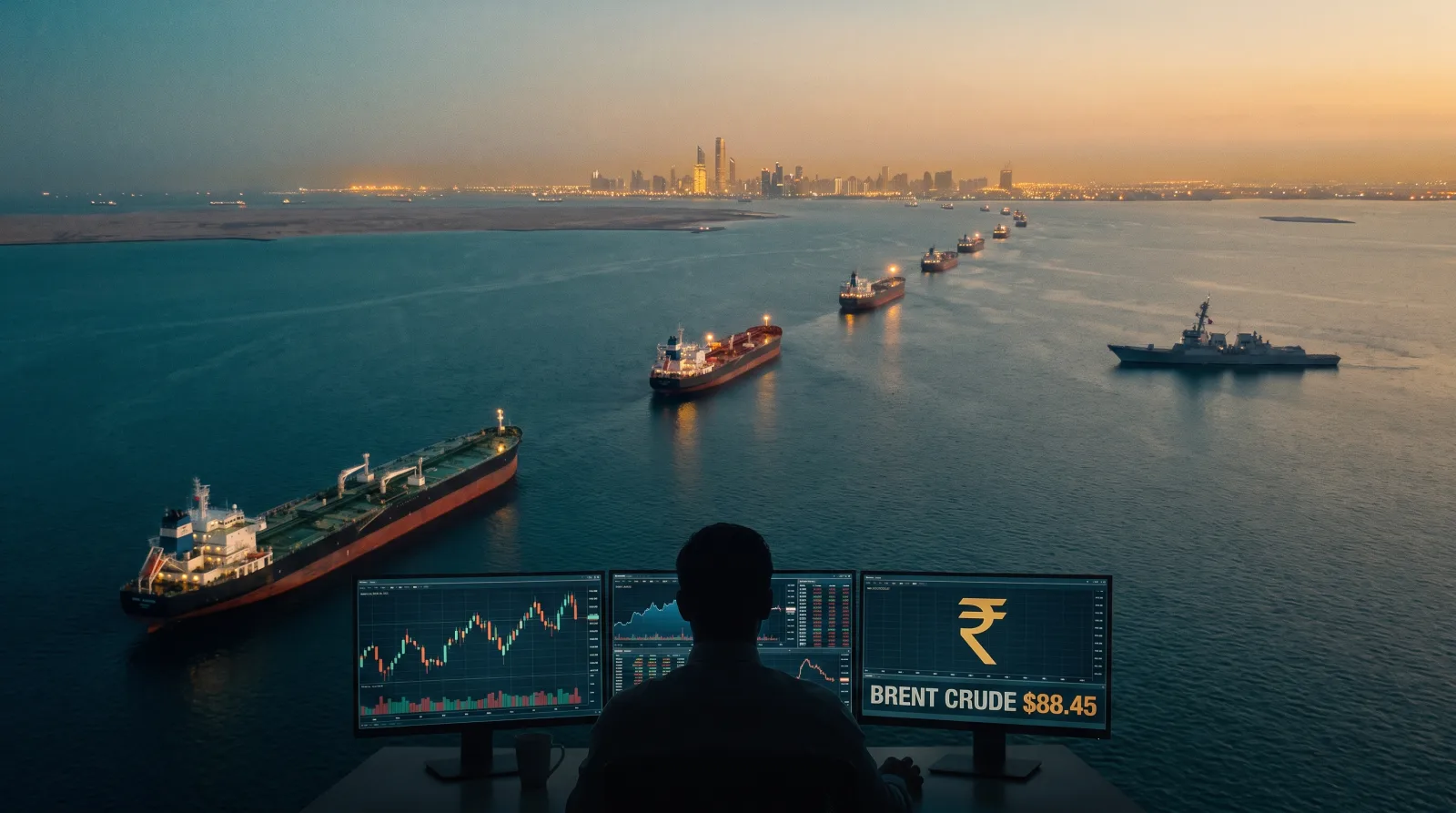
Indian benchmarks have spent the past two weeks being tugged between a robust Q1 FY27 earnings season and Middle East risk. On 14 August the second force won. The BSE Sensex slipped 70.71 points (-0.09%) to 78,009.25 and the NSE Nifty 50 fell 29.85 points (-0.12%) to 24,366.00, snapping a two-week winning streak.
The trigger was a geopolitical one with an Indian price tag. The United States has signalled it will maintain a naval blockade of Iran "indefinitely", and two tankers linked to Abu Dhabi National Oil Company were attacked in the Strait of Hormuz on 13 August. Iran has restricted traffic through the waterway, which carried about 20% of global seaborne oil flows before the conflict. Brent crude held near $87.16 a barrel, on track for a roughly 4% weekly gain, and the rupee slipped to 95.43.
For an economy that imports more than 85% of its crude, this is a repricing of the inflation, currency and margin assumptions that anchor almost every active Indian portfolio.
What happened#
The blockade threat became permanent. On 13 August the United States said it could keep its naval blockade of Iran in place indefinitely, ratcheting up economic pressure as ceasefire talks floundered. Treasury Secretary Scott Bessent warned of further measures against Tehran.
Hormuz traffic slowed further. Two ADNOC vessels were attacked on the evening of 13 August, according to UAE state news agency WAM. Iran's new Basij commander said the strait was "under the management and control of the Islamic Republic".
Indian benchmarks paid the bill. The Nifty opened 73.55 points lower at 24,322.30 and never recovered. Defence was the only major sector to close green, with the Nifty Defence index gaining 1.58%; Nifty Metal shed roughly 1%. The rupee slipped to 95.43 and FPIs turned marginal net buyers of ₹508.12 crore after two days of selling. The Nifty and Sensex each ended the week lower by roughly 0.7% and 0.5%.
Brent crude is the global benchmark for seaborne oil, drawn from the North Sea. It anchors roughly two-thirds of the world's oil contracts, including what India pays, and is denominated in US dollars.
The Strait of Hormuz is a 21-mile-wide chokepoint between Iran and the Arabian Peninsula. Before the current conflict, about 20% of the world's seaborne oil transited it. There is no pipeline alternative at scale.
The current account deficit (CAD) is the gap between a country's exports of goods, services and primary income, and its imports. India runs a structural CAD because of its oil bill. Every $10 rise in Brent adds an estimated $8-10 billion to India's annual import bill, or 25-30 basis points of GDP.
Foreign Institutional Investor (FII) and Domestic Institutional Investor (DII) flows capture Foreign and Domestic Institutional Investor activity. FII flows are price-sensitive and pro-cyclical; DII flows, dominated by SIPs into Indian mutual funds, have been counter-cyclical for most of the last four years. As of 14 August, FIIs have withdrawn roughly ₹4.70 lakh crore from Indian equities over the past year, while DIIs have invested roughly ₹8.55 lakh crore. The oil-to-rupee transmission is mechanical: higher oil expands the trade deficit, weakens the rupee, raises imported inflation, and tightens financial conditions, even if the RBI does not move rates.
Market implications#
The shock touches almost every asset class an Indian investor holds. On equities, the index-level reaction was muted because large-cap earnings and domestic flows absorbed the headline risk, but the sectoral spread was wide. Apollo Hospitals, Bharti Airtel and Adani Ports led the Nifty 50 gainers, while Tata Motors PV, Jio Financial and Asian Paints were the worst drags. Crude-sensitive names underperformed; defensives (defence, healthcare, telecom) outperformed.
The rupee itself has held a 94.92-95.45 range for the past month, supported by the RBI's heavy intervention in the forward market and a comfortable services surplus. A break above 95.80 on a crude-driven basis would be a meaningful signal.
For fixed income, a persistent oil shock is bond-negative. It pushes headline CPI higher, raises the term-premium component of long yields, and complicates the RBI's path to the 4.7% Q2 FY27 CPI print it has pencilled in.
In the derivatives market, the F&O Closing Auction Session (CAS) rolled out in July is still in price-discovery mode. Volatility sellers have collected premium in the narrow August range, leaving the market short gamma into a potential breakdown. Realised vol on the Nifty would need to cross 14-15% before mean-reversion and risk-parity strategies are forced to delever.
How an oil shock moves an Indian portfolio#
The transmission is mechanical. A $5 move in Brent over a quarter translates into roughly 30-40 basis points of additional wholesale-price inflation, mostly through fuel and power. India imports about 4.7 million barrels per day of crude; a $5 move on the full annual bill adds roughly $8.5 billion to the import bill, or about 25 basis points of GDP. At $90 Brent, the trade deficit has historically widened by $30-40 billion from a $75 base, and the rupee weakens in proportion unless offset by capital flows.
For portfolio construction, the framework is simple. An oil shock is bond-negative, gold-positive, mildly positive for defensives, and negative for cyclicals with limited pricing power. Paints, tyres and aviation are the most exposed in India, while upstream OMCs face margin compression if the government delays a retail price hike.
Critical analysis#
The blockade is more bark than bite so far. US-Iran ceasefire talks have stalled, but OPEC and the IEA have both lowered their 2026 demand growth forecasts this week. The IEA on 12 August forecast global oil supply would fall by 4.3 million barrels per day in 2026, up from 3.7 mb/d a month ago, but US crude inventories just posted their largest weekly increase in more than three and a half years. That is the offsetting supply reality the market is also pricing.
DII flows can carry equities, but not the rupee. The ₹4.96 lakh crore of cumulative DII buying has more than offset FII selling, but it is equity-only. There is no equivalent DII bid in the bond market, and the FX market remains structurally short dollars when oil rises. The RBI can smooth volatility; it cannot reverse the trend.
Geopolitics tend to mean-revert. Three of the last four Middle East shocks to Indian markets saw the Nifty recover its losses within 30-60 trading sessions provided Brent did not stay above $95 for more than a quarter. A prolonged Hormuz closure is the real risk; a noisy one is a buying opportunity for long-horizon capital.
India has lived through three structural crude shocks since 2008. The 2008 spike to $147, the 2014-16 shale-driven bust, and the 2022 Russia-Ukraine surge to $139 all produced the same pattern: a 10-15% Nifty drawdown within three months, a rupee weakening to fresh lows, and an RBI holding or tightening off-cycle. In each case the recovery was V-shaped, not U-shaped.
Today's episode is more contained but more persistent. The 2008 and 2022 spikes were demand shocks layered on supply shocks; today is a supply event against a weakening demand backdrop, arguing for a more muted drawdown but a slower recovery, with a Brent price ceiling closer to $95 than $140. The structural break is in the rupee: from a 68-75 range before 2022 to a 95-plus range today, with the trade deficit now structurally wider and the FX reserve buffer thinner.
Key takeaways#
- The Sensex and Nifty snapped a two-week winning streak on 14 August, with the Nifty closing at 24,366.00 (-0.12%) and the Sensex at 78,009.25 (-0.09%), as the US-Iran naval blockade and tanker attacks in Hormuz pushed Brent crude to a roughly 4% weekly gain near $87 a barrel.
- India's macro vulnerability is asymmetric. The country imports more than 85% of its crude, and every $5 move in Brent adds an estimated $8-10 billion to the import bill, or 25-30 basis points of GDP.
- FII flows turned marginally positive (+₹508 crore) but remain a structural drag, with one-year outflows of roughly ₹4.70 lakh crore against DII buying of ₹8.55 lakh crore. The rupee is being defended by the RBI's forward-market intervention, not by capital flows.
- Sectoral positioning matters more than index timing. Crude-sensitive names (paints, tyres, aviation, OMCs) are likely to underperform; defensives (healthcare, defence, telecom, select IT) are likely to hold. Gold is the cleanest macro hedge.
- The base case is a V-shaped recovery if Brent stays below $95 and the blockade remains a credible threat. A break above $95, or a sustained Hormuz closure, would force the RBI off its neutral stance.
Frequently asked questions#
What is the US naval blockade of Iran, and why does it matter for India? The blockade is a US maritime operation restricting Iran's shipping and ports to cut off Tehran's oil revenue. India is one of the world's largest importers of crude, and the Strait of Hormuz, the route through which most Gulf crude flows, carried about 20% of global seaborne oil before the current conflict. A sustained blockade tightens supply and pushes up the prices India pays in dollars.
Why did the Nifty fall today if FIIs were net buyers? FII flows were only marginally positive at +₹508 crore after two consecutive sessions of net selling. The bigger drag was the crude shock, which pressured crude-sensitive sectors, and the rupee slip to 95.43, which compressed risk appetite. Mid-caps fell 0.53% and small-caps fell 0.69%.
How does higher crude affect Indian inflation? Crude feeds into retail fuel prices, transportation, and input costs for petrochemicals, paints, tyres and aviation. A $5 sustained rise in Brent adds an estimated 30-40 basis points to wholesale inflation. The RBI's Q2 FY27 CPI forecast of 4.7% assumes relatively benign crude, so a move above $90 would force an upward revision.
Which Indian sectors benefit from a Hormuz crisis? Defence stocks and upstream producers tend to benefit. Domestic refiners configured to buy discounted Russian crude, which hit a record share of India's imports in July, also enjoy a margin advantage.
What would force the RBI to change policy? A sustained crude print above $95, a one-off 50+ basis point CPI upside surprise, or both. The MPC's neutral stance allows it to act in either direction, but the bias is asymmetric: an oil-driven inflation shock would more likely delay further easing than trigger a hike.
References#
- Stock Market Today Live - Times of India
- Closing Bell, 14 August 2026 - Kotak Neo
- Indian Stock Market Closing Wrap - Markets Today on X
- Stock Market Update 14 August 2026 - Kotak Neo
- Sensex, Nifty Slip at Open - HDFC SKY
- FII DII Data - ScanX
- FII DII Data - Tapetide
- Oil prices today: Crude edges higher - Times of India
- US eyes indefinite Iran naval blockade - The Straits Times
- US signals long-term Iran naval blockade - India Today
- Oil Near $87 as US Threatens Iran Blockade - HDFC SKY
- Crude Oil Price - Trading Economics
- US warns Iran, two more ships attacked in Hormuz - SRN News
- Oil Gains 4% on Blockade Threat - Crux Investor
- Rupee gains 2 paise to 95.43 - The Hindu
- RBI MPC Highlights - Business Standard
- FII & DII Trading Activity - IIFL Capital
- Rupee falls 13 paise to settle at 95.43 - The Hindu
- NSE FII/DII data - NSE India