TCS Buys Porsche's MHP: India's IT Giant Bets Big on AI and Cars
TCS is buying Porsche's consulting arm MHP for €320 million and has signed a €1.25 billion AI deal. Here is what the acquisition means for India's largest IT firm.
India's largest technology company just paid to sit in the driver's seat of Europe's car industry. On 24 August 2026, Tata Consultancy Services agreed to buy MHP, the management and IT consultancy owned by Porsche, for an enterprise value of €320 million. Alongside the purchase, Porsche committed to a five-year strategic partnership worth €1.25 billion with TCS and MHP. For a sector that has spent 2026 worrying about whether artificial intelligence will eat its lunch, this is the clearest sign yet of how India's IT champions plan to fight back: buy the domain expertise, then sell the AI.
Why this deal matters more than its price tag#
At roughly ₹3,573 crore, the MHP purchase is not large by the standards of a company of TCS's size. What makes it important is timing and direction. TCS shares are down 29% for the year, making the stock one of the worst performers on the Nifty in 2026, as investors fret that generative AI will compress the billable hours that built the Indian outsourcing model. The Porsche deal is a direct answer to that fear. It hands TCS a marquee European client it did not previously have, deepens its presence in Germany's automotive heartland, and gives it a live laboratory for selling AI as a transformation service rather than as cheaper code. In a week when the broader market was quiet, with the Sensex barely moving, this was the single corporate story with genuine strategic weight for India Inc.
What happened#
TCS, through its Dutch subsidiary Tata Consultancy Services Netherlands B.V., signed a share purchase agreement to acquire 100% of MHP Management- und IT-Beratung GmbH from Dr. Ing. h.c. F. Porsche AG. MHP is headquartered in Ludwigsburg, near Stuttgart, employs more than 4,500 people and reported calendar-year 2025 revenue of €742 million. At €320 million enterprise value, TCS is paying about 0.4 times MHP's annual sales. That is an unusually low multiple, and it reflects MHP's thin margins and heavy reliance on its parent.
The second, larger piece is the partnership. Porsche has agreed to spend €1.25 billion over five years with TCS and MHP to, in the words of TCS chief executive K. Krithivasan, "industrialise AI at scale for Porsche" across engineering, manufacturing, operations and customer experience. TCS will set up a dedicated AI Mobility Centre of Excellence to anchor the work. MHP will keep its brand and operate as an independent consultancy inside TCS. The transaction still needs customary regulatory and competition approvals and is expected to close within three to four months.
For Porsche, the sale is part of its "Sportwagenschmiede 35" strategy (a German phrase meaning roughly "sports-car forge"), under which chairman Michael Leiters is refocusing the company on its core business after a bruising stretch of falling China sales and a costly electric-vehicle transition. Selling MHP raises cash and hands the digital heavy lifting to a specialist.
The mechanics: what an IT services carve-out actually buys#
To see why TCS wants MHP, it helps to unpack how these deals work. A "captive" is an in-house technology unit that a large corporation builds to serve itself. Over 30 years, MHP grew from a SAP specialist into a broad consultancy. (SAP is the German software that runs the finance, supply-chain and manufacturing systems of most large industrial firms.) Crucially, MHP is no longer purely captive: it now earns 60% of its revenue from external clients, including other automotive original equipment manufacturers, and 40% from Porsche.
That split is the key to the numbers. Of MHP's roughly €742 million in sales, the Porsche portion, around €250 to 300 million a year, is effectively locked in by the €1.25 billion, five-year commitment. The remaining ~€450 million comes from external customers that TCS must retain and grow using its own sales engine. In plain terms, TCS is buying a guaranteed revenue floor plus a door into Europe's carmakers, and paying a low price precisely because integrating an onshore, largely European and American workforce is hard and low-margin.
What it means for markets#
The immediate share-price reaction was muted. TCS opened 1.38% higher at ₹2,314.55 on the BSE, then reversed to trade around ₹2,263, a modest decline. That tepid response tells its own story: investors like the strategy but are waiting for proof of execution, and the deal does little for near-term earnings.
Brokerages are broadly, if cautiously, positive. Nuvama retained a 'Buy' with a ₹3,000 target (valuing TCS at 18 times estimated FY28 earnings), calling the deal earnings-neutral but revenue-accretive by about 3% and "a better use of cash than a dividend or buyback." JM Financial kept an 'ADD' with a ₹2,205 target, citing MHP's German relationships. Emkay Global, also 'ADD' with a ₹2,600 target, was blunter about the costs, estimating the deal would be about 50 basis points dilutive to operating (EBIT) margin and slightly dilutive to earnings per share in the first year.
The wider read-across is for Nifty IT as a whole. If TCS can convert a captive carve-out into recurring AI-led transformation revenue, peers such as Infosys, Wipro and HCLTech will feel pressure to make similar moves in Europe and among industrial clients. It also nudges the narrative on the rupee and services exports: Germany and continental Europe are becoming as important to Indian IT growth as the United States, which matters for a sector that is India's largest net earner of foreign exchange.
The technical core: what "industrialising AI" means#
The phrase TCS keeps using, "industrialise AI at scale", deserves scrutiny, because that is where both the value and the risk sit. Most enterprises have run AI pilots. Very few have moved them into daily production across a factory or an engineering department. Industrialisation means turning a promising model into reliable, governed infrastructure: standardised data pipelines, retraining schedules, monitoring for model drift (when a model's accuracy decays as the real world changes), audit trails for regulators, and integration with the SAP and engineering systems that already run the business.
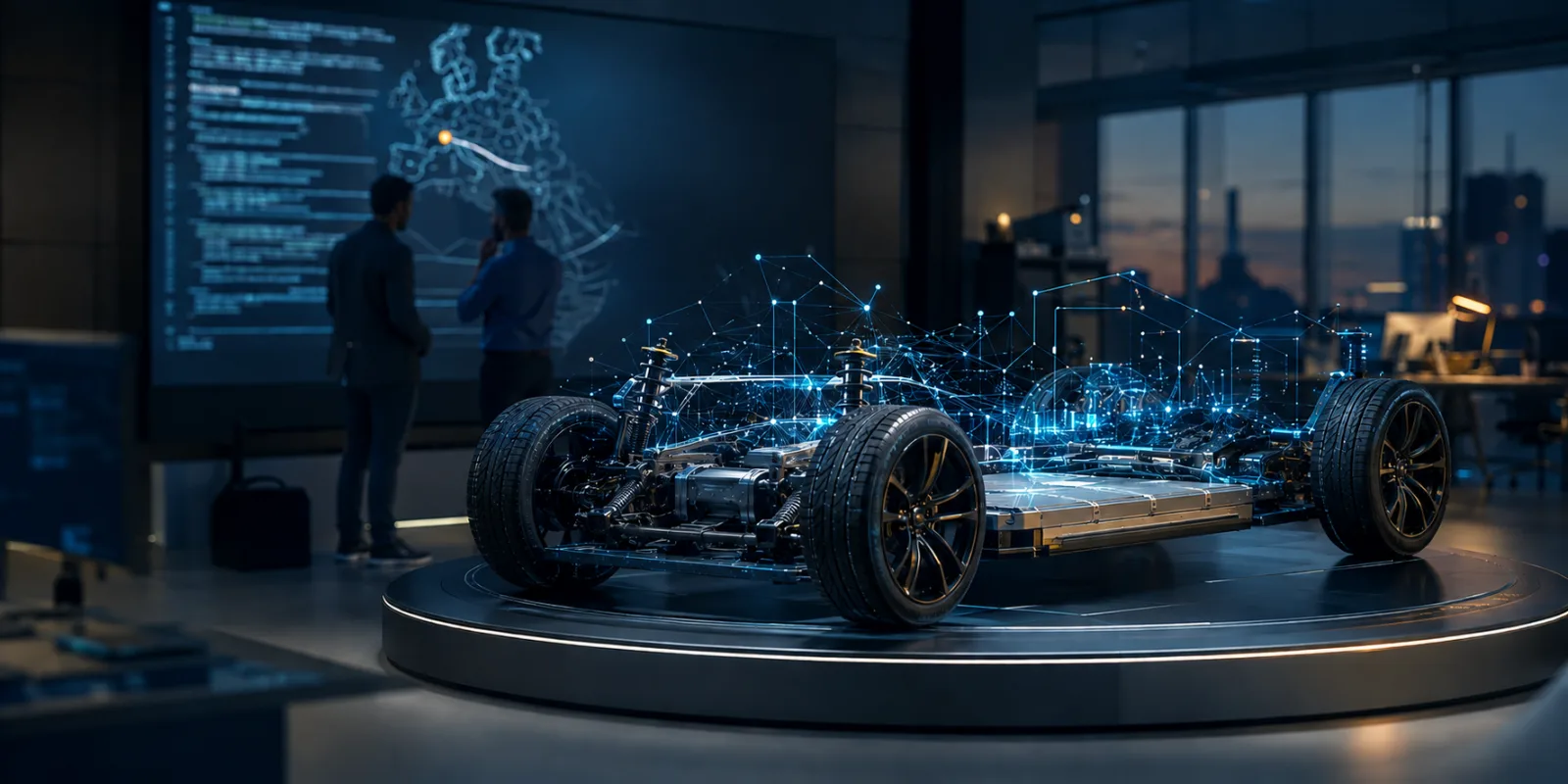
In automotive specifically, this points at "software-defined mobility". This is the idea that a modern car's value increasingly lives in its software and data rather than its mechanical parts, much as a smartphone's value lies in its operating system and apps rather than its casing. Building software-defined vehicles requires exactly the blend the two firms are describing: MHP's understanding of automotive engineering and manufacturing, plus TCS's capacity to deliver large, repeatable technology programmes. The AI Mobility Centre of Excellence is the vehicle for productising that combination and, eventually, reselling it to other carmakers.
The bull and bear cases#
TCS acquires a decades-old brand, 4,500 skilled consultants and instant credibility with German industry, at a modest valuation and with a large anchor contract attached. It gains a hedge against AI-driven deflation in traditional services by moving up the value chain into consulting and outcomes.
However, MHP's staff are largely based in higher-cost European and US locations, so the business runs at low-to-mid single-digit margins that will dilute TCS's own, much higher margins for at least the first two years. Retaining talent and clients through an ownership change is notoriously difficult. And the whole thesis rests on the health of a seller that is itself under strain: Nuvama's main concern is Porsche's own finances, given the automotive downcycle and fierce competition from Chinese electric-vehicle makers. If Porsche cuts spending, the €1.25 billion floor could prove softer than it looks. There is also timing sensitivity at the top of the house: the Tata Sons board is expected to meet on 17 September amid a leadership succession, a reminder that this deal lands during a period of change at the Tata Group.
Where this sits in history#
This is neither a one-off nor a revolution; it is the latest move in a well-worn Indian IT playbook. When a Western manufacturer wants to cut costs, it sells its in-house technology arm to a services firm that promises savings and a long-term contract. Nuvama explicitly likened the MHP deal to HCL Technologies' purchase of Volvo's external IT business in 2016 and to LTIMindtree's more recent acquisition of Randstad's IT operations. Each followed the same logic: buy cheap, bank a revenue bump, and open a door to a new region.
What is new is the AI framing. Earlier captive carve-outs were about labour arbitrage, meaning the same work done more cheaply from India. The Porsche partnership is pitched as the opposite: keeping high-cost consultants close to the client and selling judgement, domain knowledge and AI systems rather than headcount. If that model works, it represents a structural shift in how Indian IT earns money, not merely a cyclical deal. If it does not, it will look like an expensive way to buy a single client. The fairest verdict today is that this is an incremental, sensible step dressed in the language of transformation, and the market has priced it accordingly.
Key takeaways#
- TCS is buying MHP for €320 million (about ₹3,573 crore) and separately signed a five-year, €1.25 billion AI partnership with Porsche.
- The valuation is cheap at roughly 0.4x MHP's €742 million CY2025 revenue, reflecting thin margins and heavy reliance on Porsche for 40% of sales.
- It is a strategic hedge, not an earnings driver. Analysts see it as broadly EPS-neutral, ~3% revenue-accretive and mildly margin-dilutive for the first year or two.
- The prize is Europe and AI credibility: a German foothold, a new automotive anchor client and a template for selling "industrialised AI."
- The risk is Porsche itself. A struggling seller facing an auto downcycle and Chinese competition could weaken the deal's guaranteed revenue floor.
Frequently asked questions#
What exactly is MHP? MHP is a German management and IT consultancy, founded over 30 years ago and headquartered in Ludwigsburg near Stuttgart. It began as an SAP specialist and now advises automotive, manufacturing, aerospace, defence, energy and public-sector clients on digital transformation and AI.
How much is TCS paying, and how? An enterprise value of €320 million (about $373 million or ₹3,573 crore), through its Dutch subsidiary, for 100% of MHP. The deal is separate from the €1.25 billion services contract Porsche committed to over five years.
Why did TCS shares not rise? Because the deal does little for near-term profit. It is broadly earnings-neutral and slightly margin-dilutive at first. The stock is already down 29% in 2026 on AI-disruption worries, and investors want proof of execution.
When will the deal close? Within three to four months, subject to regulatory and competition-law approvals.
Will MHP keep its name? Yes. MHP will retain its brand and operate independently within TCS, and Porsche will remain a client.
What does this mean for other Indian IT firms? It raises the bar. If TCS turns a captive carve-out into recurring AI revenue, rivals such as Infosys, Wipro and HCLTech will face pressure to pursue similar European, industrial-sector deals.
Is this TCS's biggest acquisition? It is among its larger deals, but the strategic partnership value (€1.25 billion) dwarfs the €320 million purchase price. The significance lies in the client relationship, not the acquisition size.
Glossary#
- Enterprise value (EV): A measure of a company's total value, including its equity and debt. Here, €320 million is the price TCS assigns to the whole of MHP.
- Captive unit: An in-house technology or service team that a corporation builds to serve itself, which can later be sold to a specialist provider.
- EV/sales multiple: The enterprise value divided by annual revenue. MHP's ~0.4x is low, signalling a modest price relative to sales.
- EPS-neutral: A deal that does not materially change earnings per share, the profit attributable to each share.
- Margin dilution: A fall in a company's profit margin, here because MHP's high-cost, low-margin European operations drag on TCS's higher margins.
- Software-defined mobility: The shift in which a vehicle's value increasingly comes from its software and data rather than its mechanical hardware.
- Model drift: The gradual decline in an AI model's accuracy as real-world conditions change, requiring monitoring and retraining.
- Original equipment manufacturer (OEM): In cars, the brand that designs and assembles the vehicle, such as Porsche, Volvo or Tata Motors.
References#
- Porsche Newsroom: Porsche sells MHP to Tata Consultancy Services (primary source, 24 August 2026)
- TCS Newsroom: TCS and Porsche AG Partner to Accelerate the Future of AI-Powered Mobility (company announcement)
- Business Standard: TCS to acquire Porsche subsidiary MHP for $373 mn, signs five-year deal
- Business Standard: TCS reverses early gains, down 1%: What deal with Porsche means for company
- Business Today: TCS share price target: Porsche's IT consulting arm buyout EPS neutral, win-win deal
- Outlook Business: TCS to buy Porsche's IT consulting unit MHP for €320 mn
- MarketScreener: Tata Consultancy Services Netherlands B.V. executes share purchase agreement for MHP
- Porsche Newsroom: From SAP specialist to a driver of industrial transformation (30 years of MHP)
- Business Today: Tata Sons board likely to meet on September 17, Chandrasekaran exit may take centre stage
This article is for information only. It is not investment advice, a recommendation to buy or sell any security, or a forecast. Figures and analyst targets are as reported on 24 and 25 August 2026 and may change. Analyst price targets and ratings reflect the views of the respective brokerages, not those of the author.