Dhoot Transmission IPO Closes at 74x. Bain-Backed EV Supplier Tests India's Maturing Primary Market
Dhoot Transmission's ₹3,067-crore IPO closed at 74.21x overall and 212.92x in the QIB category, becoming the most heavily subscribed automotive issue of the year and a litmus test for institutional conviction in a cooling Indian primary market.
This year, India's primary market has done something no one quite expected. It raised a record ₹1.77 lakh crore across 109 mainboard IPOs, then watched the average listing-day gain collapse from 29% in FY25 to 7% in FY26. Easy money is gone, investors have turned pickier, and the IPOs that still get bid hard are the ones with a story, a sponsor and a defensible market position.
Dhoot Transmission is exactly that kind of issue. The Chhatrapati Sambhajinagar-based, Bain Capital-controlled maker of two-wheeler wiring harnesses closed its ₹3,066.89-crore mainboard IPO on 12 August 2026 with a 74.21x overall subscription. Inside that headline number sits a 212.92x bid in the qualified institutional buyer tranche, and the final-day surge shows where domestic and global institutional money is still happy to pay a premium in a market that has otherwise grown cautious.
What Happened?#
The three-day book-building window opened on 10 August and closed at 5:00 PM IST on 12 August. The structure is a combination issue: ₹1,400 crore of fresh capital and ₹1,666.89 crore of offer for sale, with Bain Capital-owned BC Asia Investments XV offloading roughly ₹1,395 crore and promoter entity Mangalam Capital selling about ₹272 crore. The price band ran from ₹829 to ₹871 a share, with a face value of ₹2 and a minimum retail lot of 17 shares (₹14,807 at the upper end).
Final subscription figures from the NSE and BSE showed the issue covered 74.21 times overall. The QIB (ex-anchor) portion was bid 212.92 times, the NII segment 51.93 times, and retail individual investors 8.12 times. Total bid value reached ₹1,61,307 crore against shares on offer worth ₹612 crore to QIBs, ₹243.93 crore to NIIs and ₹89.02 crore to retail. The arithmetic is striking because the QIB book is mathematically bounded by the anchor allocation: once the anchors took their 30%, the residual was small.
Anchors had already committed ₹918.27 crore on 7 August, with 72 investors taking 1.05 crore shares at the upper band. Domestic mutual funds absorbed 61.27% of that anchor book, and life insurers and pension funds took another 8.74%. The grey market premium traded in the ₹240–₹260 range on the eve of closure, implying a 28–30% listing-day pop. Allotment is being finalised on 13 August, with listing scheduled on NSE and BSE on 17 August.
How a Book-Built Indian IPO Actually Works#
A few terms are worth pinning down for readers who don't sit on a primary-market desk. A book-built issue lets investors bid within a price band, and the final cut-off price is discovered by demand. Unlike a fixed-price issue, the issuer does not know the issue price until the book closes. SEBI mandates reservation categories: at least 50% of the net offer goes to qualified institutional buyers, 15% to non-institutional investors (HNIs and family offices), and 35% to retail individual investors. Anchor investors are a sub-set of QIBs who commit capital a day before the issue opens, in exchange for an assured allocation and a 30-day lock-in.
That lock-in matters. Anchors are buying for the medium term, not flipping on listing day, so anchor demand is a better signal of institutional intent than headline subscription. A "subscription multiple" is just the ratio of shares bid to shares on offer. A 74.21x figure means investors wanted 74 times the shares available. Because the categories are ring-fenced, the QIB 212.92x figure is the more informative one. At that level, a QIB bidding for ₹100 crore of stock would receive a proportionate allotment of roughly ₹0.47 crore.
The grey market premium is the unofficial premium at which the unlisted stock trades in a parallel, cash-settled market. It is unregulated, often noisy, and a sentiment indicator at best. In this case, a ₹250 GMP over an ₹871 issue price translates to a theoretical listing near ₹1,121, or a 28.7% day-one gain. Investors who treat the GMP as a guarantee are usually the ones who learn the hardest way.
Market Implications#
The closure of Dhoot Transmission is, in microcosm, the FY26 IPO market in three numbers: a record-sized supply, an institutional bid that punches well above its weight, and a retail book that is healthy but not euphoric.
For equity markets and primary issuance, a 74x subscription with a 213x QIB tranche does two things. First, it confirms that India's institutional liquidity pool (domestic mutual funds, insurance companies, sovereign and pension allocators) has not thinned despite the broader mid-cap correction. Second, it implicitly tests the FY26 thesis that "easy money" is gone. Even at a 44.9x P/E on FY26 EPS of ₹19.4 (a 30% discount to the small-cap auto-component average, but well above the broader Nifty auto multiple), the paper was over three times oversubscribed at the upper band, which is the price-discovery mechanism doing its job.
For foreign exchange and the rupee, QIB bidding is largely funded by foreign portfolio investors using rupee liquidity, so a 212x QIB book draws marginal FPI demand. It is not, on its own, a rupee-positive event at the macro level, but it does signal that global allocators, among them the Abu Dhabi Investment Authority, BlackRock, Pictet, Amundi and Allianz, are willing to underwrite India manufacturing exposure at a moment when the dollar-rupee pair has been bid defensively.
For fixed income and the cost of capital, the fresh issue proceeds are earmarked for debt repayment and capex at new plants in Haryana and Tamil Nadu. Net debt reduction at the issuer level feeds into the broader credit-transmission story: a deleveraged corporate sector compresses the credit risk premium on AAA and AA paper.
On the derivatives side, stock futures on Dhoot Transmission will trade from listing day, and the unusually high QIB interest is likely to translate into elevated implied volatility. Quant desks running pre-listing pairs trades (long GMP-implied listing versus short sector index) will be active, and delta-hedging on opening day tends to amplify moves.
For banking, fintech and institutional flows, the fact that domestic mutual funds took 61% of the anchor book underlines a structural shift documented by Grant Thornton Bharat's FY26 report: for the first time, mutual funds surpassed FPIs as the largest anchor-investor class in Indian IPOs, contributing 14.89% of total issue size versus 13.38% from FPIs. That looks like a structural change rather than a one-off.
Why Dhoot Specifically?#
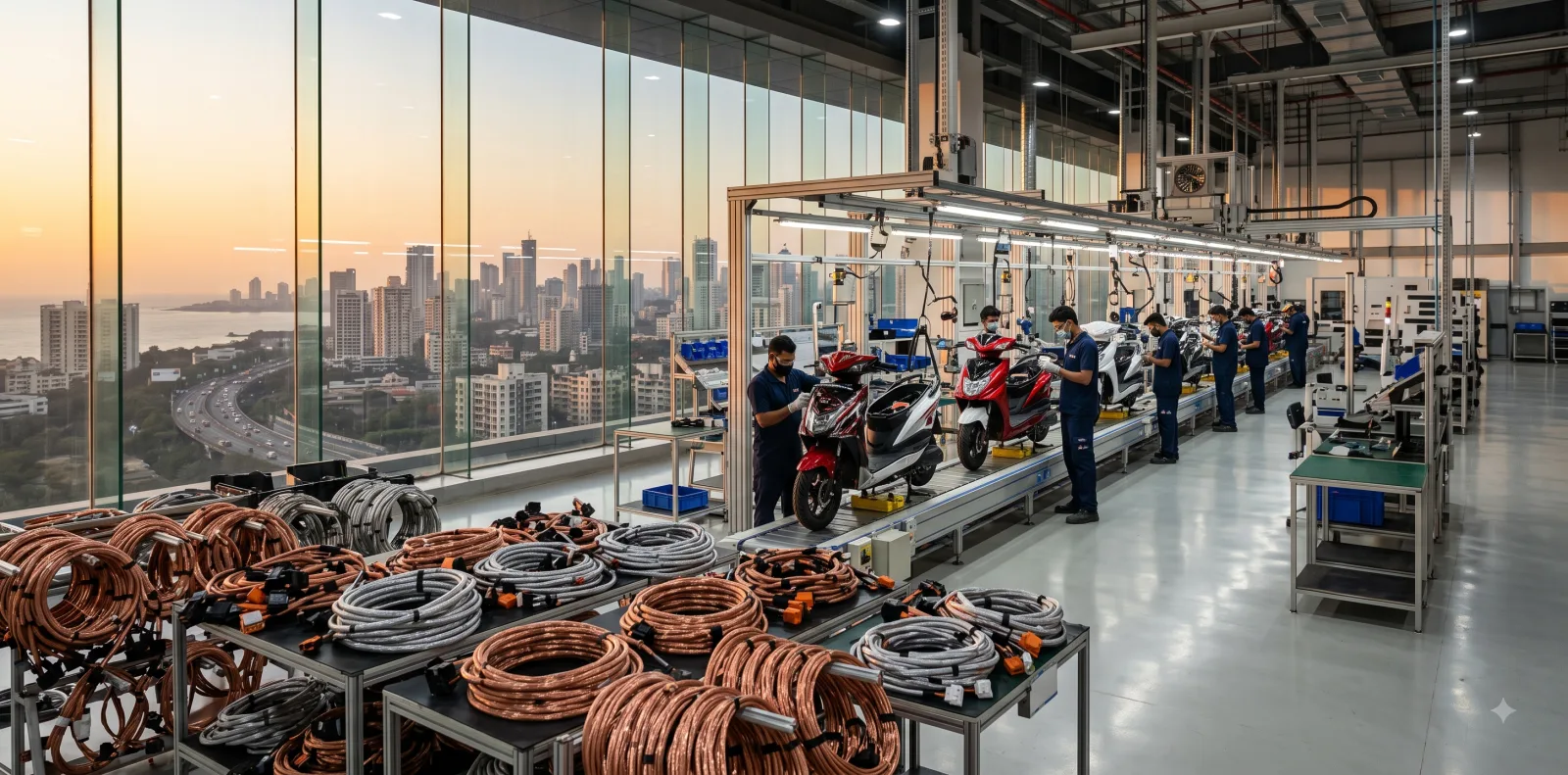
Dhoot Transmission is a vertically integrated maker of wiring harnesses, the bundles of wires, connectors, terminals and electronic controllers that carry power and data through a vehicle. In a modern two-wheeler or three-wheeler, the harness can run several metres and integrate 50–100 connectors. It is one of the most underestimated bill-of-materials items by retail investors, but a critical one for OEMs. The company is the largest pure-play player in the 2W/3W segment, with a 41% market share by value in India and roughly 70% market share in the electric two-wheeler and three-wheeler harness sub-segment, per CRISIL.
Wiring harnesses are a powertrain-neutral component for the most part: the same physical architecture can serve an internal combustion engine platform or an EV platform, with the latter simply adding high-voltage interconnection systems, battery management wiring, and charging-port looms. Dhoot's product mix is roughly 65% two-wheeler, 13% three-wheeler and 22% other vehicle categories. About 24% of FY26 revenue was EV-linked, up from 16% in FY24. The company supplies most large Indian OEMs in the 2W space and is a Tier-1 vendor to several EV pure-plays.
On the numbers, the company reported revenue from operations of ₹4,525 crore in FY26, up 31.4% year-on-year, with EBITDA of ₹711 crore (15.7% margin) and profit after tax of ₹397 crore (8.8% margin). The 27% revenue CAGR and 15% PAT CAGR over FY24–FY26 sit well above the auto-component peer average. The wiring-harness business is asset-light relative to forging or casting: return on capital employed averaged 27.4% over four years, and asset turnover is meaningfully higher than for typical auto ancillaries.
The use of proceeds matters. Roughly ₹1,400 crore of fresh capital will retire debt, while the balance funds brownfield expansion in Haryana (for the EV-2W and 3W programmes) and Tamil Nadu, and leaves a war chest for acquisitions. For a company that has historically grown 25–30% per year organically, the capacity addition effectively pre-funds two to three years of growth without diluting return ratios further.
Critical Analysis#
The strengths of the IPO thesis are easy enough to see: Bain Capital's track record, a marquee anchor book, a dominant market share in a defensive sub-segment, a portfolio that is 95% EV-focused or powertrain-neutral, and pricing power that has held operating margins in the mid-to-high teens despite raw-material cost inflation. The grey market signal of 28–30% listing premium is consistent with a high-quality mid-cap seeing institutional demand.
The risks are just as visible. EBITDA margin has compressed from 18.3% in FY24 to 15.7% in FY26 as raw material costs rose from 65% of sales to 68%. PAT margin fell from 10.7% to 8.8% over the same period. Working capital is heavy, and net cash flow from operations improved only because of a ₹1,912 crore financing inflow, not operating cash conversion. Customer concentration in the top 2W OEMs is meaningful, and a slowdown in India's two-wheeler industry (the segment has seen flat-to-declining volumes in some months of FY26) would hit revenue directly. The 44.9x FY26 P/E looks reasonable against the small-cap auto-ancillary average, but it is still demanding in absolute terms and embeds an expectation of mid-20s growth continuing for at least three years.
The competing viewpoint is worth stating. A 212x QIB subscription is partly mechanical, not a pure signal of quality. When the anchor quota absorbs 30% of the issue and 46 mutual-fund schemes participate, the residual free float in the QIB (ex-anchor) tranche is small, so the multiple inflates. A pension fund bidding for ₹500 crore into a ₹260-crore QIB (ex-anchor) book automatically produces a 1.9x cover before any other institutional bid lands. The better quality signal is the diversity of the anchor list: 72 investors, including eight domestic mutual funds, three large global EM funds, and the Abu Dhabi sovereign, plus the 61% domestic mutual fund share of the anchor book. That is hard to fake.
The implementation challenge for Bain Capital is one of timing. PE investors usually prefer to monetise after a full earnings cycle, and Dhoot's FY26 PAT growth of 12.1% is the slowest in three years. Listing at 44.9x FY26 P/E in a market where listing-day gains have moderated to 7% on average is a far more demanding environment than FY24 or FY25.
Historical Context#
To put the 74.21x and 212.92x numbers in perspective: the FY26 average oversubscription across all mainboard IPOs was 39x, and the FY25 average was 71x. Dhoot Transmission sits at the higher end of the post-pandemic cohort but not at an extreme. The SBI Funds Management IPO in July 2026 saw a 41.6x overall subscription with a 140x QIB tranche on a much larger ₹11,692-crore issue.
The closer parallel is Manipal Health Enterprises, which listed on 4 August 2026 with a ₹9,275-crore issue, listed at a 10.5% premium and was up 3% a week later, broadly in line with the FY26 average listing gain. Indo-MIM (listed 29 July) outperformed with a 44% listing-day gain, but on a smaller and more specialised issue. The historical cohort suggests a 28–30% GMP-implied listing gain is at the upper end of what FY26 has delivered for a ₹3,000-crore-class manufacturing issue, and depends heavily on broader market sentiment in the listing week.
Whether this represents a paradigm shift or a cyclical peak is the open question. The structural change in FY26 was the rise of mutual funds as anchor investors and the cooling of broad-based listing euphoria. The cyclical question is whether domestic liquidity, sitting on record household financial savings and a ₹70-lakh-crore-plus banking system, can keep underwriting ₹5-lakh-crore-plus annual IPO pipelines at 30%+ premiums. The Dhoot Transmission subscription is a strong data point for the bull case.
Key Takeaways#
- Dhoot Transmission's ₹3,067-crore IPO closed at 74.21x overall and 212.92x in the QIB category on 12 August, with allotment on 13 August and listing on 17 August.
- The QIB oversubscription is a stronger signal of institutional conviction than the headline number, given the heavy anchor allocation and broad mutual-fund participation.
- The company is the dominant 2W/3W wiring-harness supplier in India, with about 70% share in the EV sub-segment and EV revenue scaling from 16% to 24% of total sales over FY24–FY26.
- The 28–30% grey market premium implies an above-FY26-average listing gain, but valuation at 44.9x FY26 P/E leaves little room for execution slippage.
- The issue is a concrete test of the post-FY26 narrative: selective, fundamentals-driven institutional demand remains robust even as average listing gains have cooled to single digits.
Frequently Asked Questions#
Q1. What is the Dhoot Transmission IPO subscription status? The IPO closed on 12 August 2026 with 74.21x overall subscription. The QIB (ex-anchor) category was subscribed 212.92 times, NII 51.93 times, and retail individual investors 8.12 times. Allotment is being finalised on 13 August.
Q2. What is the price band and issue size? The price band is ₹829–₹871 per share, with a face value of ₹2. The total issue size is ₹3,066.89 crore: ₹1,400 crore fresh issue and ₹1,666.89 crore offer for sale. At the upper band, the minimum retail lot of 17 shares costs ₹14,807.
Q3. Who are the selling shareholders in the OFS? Bain Capital-owned BC Asia Investments XV is selling shares worth approximately ₹1,395 crore, and promoter entity Mangalam Capital is offloading around ₹272 crore. The fresh issue of ₹1,400 crore will be used for debt repayment, capex at new plants in Haryana and Tamil Nadu, and general corporate purposes including acquisitions.
Q4. What is the listing date and expected listing premium? Listing is scheduled for 17 August 2026 on NSE and BSE. The grey market premium was trading in the ₹240–₹260 range over the ₹871 upper band, implying a 28–30% theoretical listing-day gain. GMP is unofficial and not a guarantee.
Q5. How is Dhoot Transmission different from a typical auto-ancillary IPO? Dhoot is a vertically integrated wiring-harness specialist with a 41% market share in the 2W/3W segment and approximately 70% share in the EV 2W/3W sub-segment, per CRISIL. Roughly 95% of its auto portfolio is EV-focused or powertrain-neutral, making it a direct play on India's electric-two-wheeler transition.
Q6. Why is the QIB subscription so high? Three reasons. First, the anchor book absorbed 30% of the issue, leaving a smaller free float for non-anchor QIBs. Second, the anchor list is unusually broad: 72 investors including BlackRock, ADIA, and SBI MF. Third, the post-FY26 environment has concentrated institutional capital into a handful of high-quality manufacturing issuers rather than spread it across the full IPO calendar.
Q7. How does this IPO fit into the broader FY26 primary market story? FY26 saw a record ₹1.77 lakh crore raised across 109 mainboard IPOs, but average listing-day gains cooled to 7% (from 29% in FY25) and average oversubscription fell to 39x (from 71x). Dhoot Transmission is a counter-example: a high-quality manufacturing issue that has drawn extraordinary institutional demand, illustrating the selective nature of the new primary-market regime.
Q8. What are the key risks for the stock post-listing? Margin compression (EBITDA margin fell from 18.3% in FY24 to 15.7% in FY26), dependence on top 2W OEMs, working-capital intensity, and a demanding 44.9x FY26 P/E that bakes in continued 25%+ growth. A slowdown in India's two-wheeler industry or sharp raw-material inflation would be the most direct catalysts.
References#
- Dhoot Transmission IPO Day 3: Issue ends with over 74x subscription — Upstox
- Dhoot Transmission IPO Subscription Status — Economic Times
- Dhoot Transmission IPO Day 2: GMP signals 30% listing gain — Economic Times
- Dhoot Transmission raises Rs 918 crore from 72 anchor investors — Economic Times
- Dhoot Transmission allotment likely today — Economic Times
- Dhoot Transmission IPO Subscription Status Live — IPO Wiz
- Dhoot Transmission IPO: Analysts recommend subscribe or avoid — CNBC TV18
- Dhoot Transmission IPO: Price, Dates, P/E Ratio — INDmoney
- Dhoot Transmission IPO Review 2026 — IPOLYST
- ICICI Direct IPO Note — Dhoot Transmission Limited
- Anand Rathi IPO Note — Dhoot Transmission Limited
- Choice Securities IPO Note — Dhoot Transmission Limited
- Dhoot Transmission Financials — Tofler
- Dhoot Transmission's wired to grow — Energy Economic Times
- ScanX Trade — Dhoot Transmission IPO Key Details
- India IPO market raised a record ₹1.9 trn in FY26 — Business Standard
- ₹1.77 lakh crore IPO fundraising, but listing gains fell to 7% — Business Today
- Indian firms raise ₹1.9 lakh crore through IPOs in FY26 — The Hindu BusinessLine
- India's biggest IPO this year rakes in bids worth $31 billion — CNBC
- August 2026 IPO Boom: 11 Mainboard Issues — Fortune India
- Upcoming IPOs: 5 mainboard issues to Rs 7,500 cr next week — Business Today
- SEBI clears 9 mainboard IPOs as 2026 queue grows fast — Multibagg.ai
- IPO Watch — Mainboard IPO 2026
- Dhoot Transmission Limited — INDmoney, Book Running Lead Managers
Disclaimer: This article is for informational and educational purposes only. It is not personalised investment advice, a trading recommendation, or a portfolio-allocation suggestion. All forward-looking statements are estimates and not certainties. Past performance of IPOs is not a reliable indicator of future results. Investors should conduct their own due diligence and consult a SEBI-registered investment adviser before making any investment decision. All data is sourced from publicly available exchange filings, company RHPs, and reputable financial publications as of 12 August 2026.