
Personal Finance and Commodities
Making Charges Are Eating 20% of Your Jewellery Bill. Here's How to Cut Them
Two shops, the same 10-gram chain, the same gold rate, and a ₹31,953 gap in the final bill. Here is how making charges and wastage are built up, what BIS says your invoice must disclose, and which levers actually reduce the number.
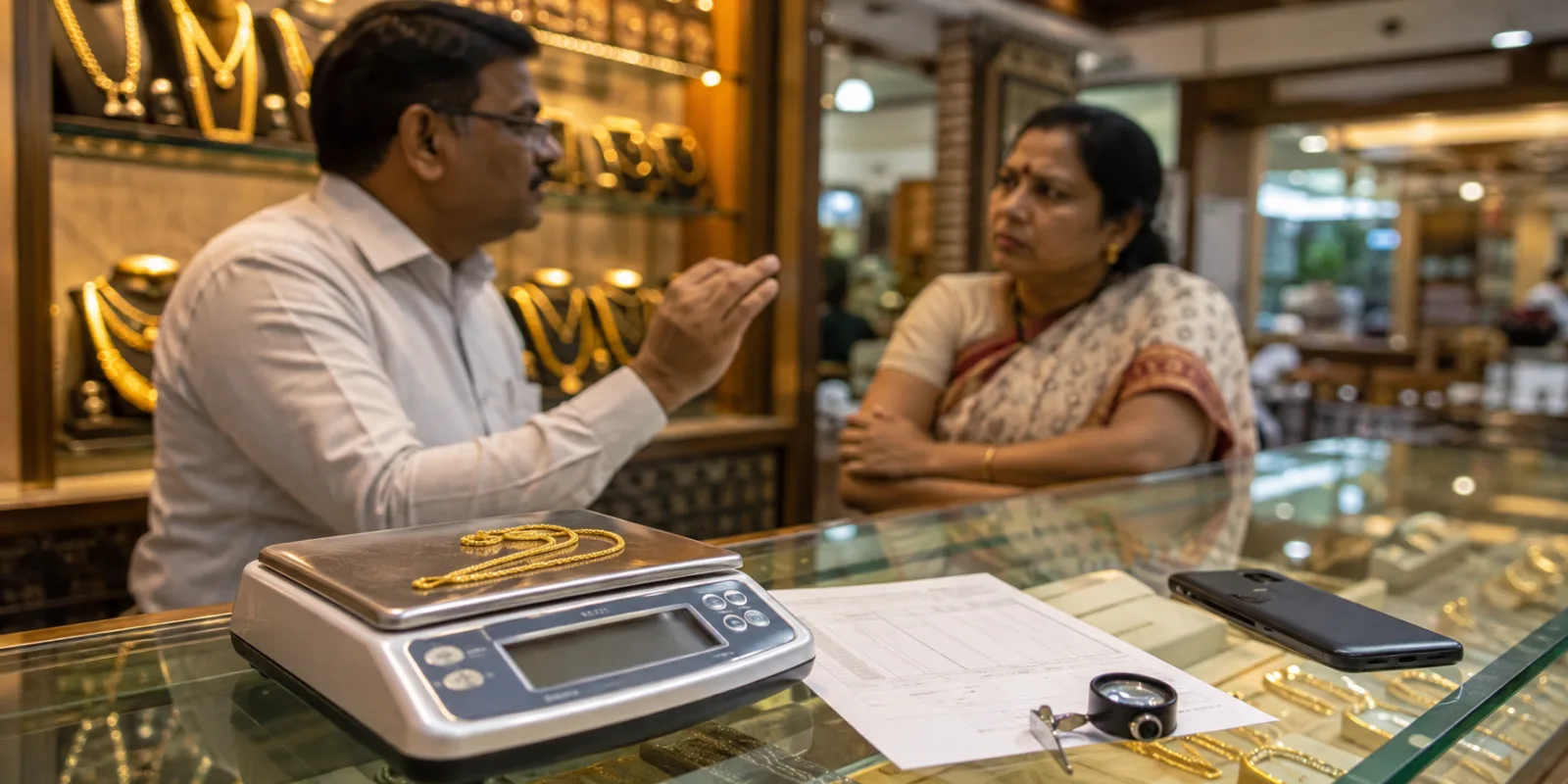
The line on your jewellery bill that has nothing to do with gold#
Walk into two shops on the same street the same morning and ask for a plain 10-gram gold chain. Both will quote roughly the same rate for the metal, because the India Bullion and Jewellers Association publishes a daily benchmark the trade follows. On 3 September 2026 it put 22-carat (916) gold at about ₹14,101 a gram.
Then the bills part company. One comes to around ₹1.50 lakh, the other to ₹1.82 lakh. Same weight, same purity, same morning.
The gap is making charges, and at the top of the range they swallow close to a fifth of what you hand over. The metal price is already doing plenty of damage. The World Gold Council found Indian jewellery demand fell 15 per cent by weight year on year in the second quarter of 2026 while its value rose 34 per cent to ₹1.13 lakh crore. Households are buying less gold and paying more for it. The labour charge on top is the one part you can still argue about.
What you are actually paying for#
A jewellery bill has four parts, and only one of them is gold.
Metal value is weight times the rate for that purity. Purity is measured in carats out of twenty-four, so 22K is 91.6 per cent gold and 18K is 75 per cent. BIS permits six grades under IS 1417:2016, 14K to 24K, and added 9-carat at 375 fineness in July 2025 as prices climbed out of reach.
Making charges are the labour: the karigar's time, the design, the shop's rent and margin. ClearTax puts the range at ₹300 to ₹1,000 a gram, or 3 to 25 per cent of gold value. A very wide band for the same object.
Wastage is a separate charge for metal said to be lost in melting and polishing, commonly 5 to 7 per cent of weight and higher on handmade work.
Tax and hallmarking finish the bill, and this is where buyers are most often misinformed. The government's sectoral FAQ on gems and jewellery says tax "is payable at the rate of 3% of the total transaction value of jewellery, whether the making charge is shown separately or not". A shop that tells you making charges attract 5 per cent GST is quoting the job-work rate, which applies between a manufacturer and a job worker, not to you. Hallmarking itself costs almost nothing: ₹45 per gold article, minimum ₹200 a consignment, whatever the weight.
The arithmetic, on one chain#
Take that chain at ₹14,101 a gram, so ₹1,41,010 of metal, and change nothing but the making charge.
| Making charge | Labour billed | GST at 3% | Final bill | Labour as share of bill |
|---|---|---|---|---|
| 3% | ₹4,230 | ₹4,357 | ₹1,49,598 | 2.8% |
| 8% | ₹11,281 | ₹4,569 | ₹1,56,860 | 7.2% |
| 15% | ₹21,152 | ₹4,865 | ₹1,67,026 | 12.7% |
| 25% | ₹35,252 | ₹5,288 | ₹1,81,550 | 19.4% |
Computed from the IBJA 916 rate for 3 September 2026 and the 3 per cent GST on total transaction value.
Cheapest row to dearest is ₹31,953, which would have bought two more grams of gold. Talking a jeweller down from 15 per cent to 8 per cent saves ₹10,167. Notice too that tax rises with labour, because GST is charged on the whole bill. You pay 3 per cent on the making charge as well.
So the headline stands up. At 25 per cent, labour is 19.4 per cent of what leaves your pocket: the top of the range rather than the average, but plenty of buyers land there without being told.
Wastage, the charge nobody questions#
Wastage hides inside the weight rather than sitting on the bill where you can see it. If a shop adds 8 per cent, above the range ClearTax describes, your 10-gram chain is billed as 10.8 grams: ₹11,281 of gold you never take home.
Put that on top of a 15 per cent making charge and the bill reaches ₹1,80,388, of which ₹34,124 before tax buys no metal at all. That is 18.9 per cent of the total, and ₹13,362 worse than the same making charge with no wastage.
Several large chains now quote a single all-in making charge instead of billing wastage apart, so ask which you are being given before you argue about the percentage. Twelve per cent all-in beats 8 per cent plus wastage. And treat heavy wastage on a machine-made item with suspicion. Handmade temple work loses metal in the fire. A stamped chain does not.
Seven levers that move the number#
- Ask for the break-up in writing, and know you are owed it. BIS guidelines require the invoice for a hallmarked article to show a separate description of each item, the net weight of precious metal, the purity in carat and fineness, and the hallmarking charges. A jeweller who will not itemise is not following the rules.
- Buy plain and machine-made when the point is value. Making charges track labour, so a cast chain sits near the bottom of the range and filigree or jadau at the top.
- Negotiate the percentage, never the rate. The metal price is a published benchmark no shop controls. The labour charge is the shop's own call, and the only part with slack in it.
- Get the stones weighed separately. On studded pieces, stone weight is sometimes billed at the gold rate and the making charge computed on the combined weight. Ask for net metal weight.
- Consider a lower carat, but honestly. An 18K piece costs less per gram because it holds less gold, and resale is priced on fineness, so you get proportionately less back.
- If you want gold as an asset, stop buying jewellery. Bars carry premiums of 2 to 10 per cent over the market price at the same 3 per cent GST, but coins can carry minting charges of 8 to 16 per cent, so do not assume a coin is cheap.
- Read waiver offers against the base. Shops tend to advertise making-charge waivers around Dhanteras and Akshaya Tritiya, and a waiver on a 20 per cent charge is worth four times one on a 5 per cent charge.
At the exchange counter, the labour is gone#
When you sell or exchange, you are paid for metal. Nobody reimburses craftsmanship.
Zerodha's Varsity works the numbers on a ring bought in 2015: of the ₹10,000 paid then, about ₹1,200 went to value addition, and "that portion is gone forever". The gold multiplied. The ₹1,200 did not.
That matters more this year than most. The World Gold Council reports Indian retailers seeing exchange volumes rise 10 to 20 per cent in the second quarter of 2026, reaching up to 70 per cent of sales in some cases, as families traded in old ornaments rather than pay cash. Each of those writes off labour bought years earlier.
Two protections are worth carrying. Selling your own old jewellery is not a supply made in the course of business, so the Central Board of Excise and Customs, now CBIC, confirmed in 2017 that a jeweller cannot charge you GST under reverse charge. And if hallmarked jewellery later tests below its marked purity, BIS says the buyer is entitled to twice the value of the shortfall plus testing charges. A piece can be assayed at a recognised centre for ₹200, and the six-digit alphanumeric HUID checked on the BIS Care app before you pay.
Purity, at least, is now well policed: hallmarking is mandatory in 380 districts since 2 March 2026, with over 60 crore items marked, and registered jewellers climbed from 34,647 to 1,94,039 by November 2024. What a hallmark cannot tell you is whether the labour on top was fairly priced.
Key takeaways#
- On a 10-gram 22-carat chain at September 2026 rates, the gap between a 3 per cent and a 25 per cent making charge is ₹31,953 for identical metal.
- GST of 3 per cent applies to the total transaction value whether or not making charges are itemised. A shop quoting 5 per cent on labour is citing the job-work rate, which is not yours.
- Wastage is a second charge hidden in the weight. Settle whether it is included before negotiating the percentage.
- Your invoice must show net metal weight, purity in carat and fineness, and hallmarking charges. A shop that refuses is out of step with BIS guidelines.
- Making charges never come back on resale or exchange. Keep gold held as an asset in bars or coins, and buy ornaments for their own sake.
Frequently asked questions#
Are making charges regulated? No. BIS regulates purity, hallmarking and invoice disclosure. The labour charge is a commercial term, and negotiable.
Is GST charged separately on making charges? Not for a retail buyer. The official sectoral FAQ sets 3 per cent on total transaction value whether the making charge is shown separately or not. The 5 per cent figure applies to job work between a manufacturer and a job worker.
Why do two shops quote different making charges for the same design? Because the charge covers labour, design, overheads and margin rather than a standard input. Chains carrying large showroom and advertising costs tend to sit higher than a neighbourhood jeweller, though their buyback terms are often firmer.
Should I move to 18-carat or 9-carat to save money? Lower carat cuts the cost per gram, and BIS extended hallmarking to 9-carat in July 2025. Resale is valued on fineness, so you recover proportionately less. A design decision rather than a discount.
Do I pay GST when I sell my old gold to a jeweller? No. The board has clarified that an individual selling old jewellery is not making a supply in the course of business.
Does a making-charge waiver mean I got a good deal? Only if you know what it was waived from. A full waiver on a piece priced with 22 per cent built in is a discount off an inflated number.
Glossary#
Making charges. The labour and design component of a jewellery bill, quoted as rupees per gram or as a percentage of gold value.
Wastage charge. An extra charge for metal said to be lost during fabrication, added to the weight you are billed for.
Carat (K). Gold purity measured in twenty-fourths. 22K is 91.6 per cent gold, 18K is 75 per cent.
Fineness. The same purity in parts per thousand: 916 for 22K, 750 for 18K, 375 for 9K.
HUID. The six-character alphanumeric Hallmark Unique Identification stamped on hallmarked articles, verifiable on the BIS Care app.
Assaying and Hallmarking Centre. A BIS-recognised laboratory that tests purity and applies the hallmark, and where consumers can have their own pieces tested.
Job work. Processing done by one business for another, taxed at 5 per cent GST. Not the rate on a retail purchase.
A note on scope#
This explains how a jewellery bill is built and where the negotiable parts sit. It is general information, not investment advice. Rates quoted are from 3 September 2026 and change daily.
References#
- Bureau of Indian Standards, Guidelines for Jewellers: invoice disclosure under clause 7.3 and in-store display under clause 3.3, July 2026
- Bureau of Indian Standards, Hallmarking FAQs: caratage grades under IS 1417:2016, hallmarking charges of ₹45 an article, and the ₹200 consumer fire-assay fee, accessed 4 September 2026
- Bureau of Indian Standards, Consumer Protection: compensation for shortfall in marked purity and HUID verification, accessed 4 September 2026
- Central Board of Indirect Taxes and Customs, Sectoral FAQ on gems and jewellery: 3 per cent on total transaction value and the 5 per cent job-work rate, hosted by the GST Council
- Central Board of Excise and Customs (now CBIC), Press release on reverse charge for old gold ornaments sold by individuals, reasoning from section 9(4) as it then stood, 13 July 2017
- Press Information Bureau, Over 40 crore gold items hallmarked with HUID; registered jewellers, AHC counts and phase-wise district coverage, November 2024
- News on AIR, Seven more districts added in the sixth phase of mandatory hallmarking; 380 districts and over 60 crore items, 12 March 2026
- World Gold Council, Gold Demand Trends: India Focus, Q2 2026
- India Bullion and Jewellers Association, published rates for 999, 916 and 750 fineness, 3 September 2026
- Business Standard, BIS extends hallmarking to 9-carat gold at 375 fineness, 21 July 2025
- Business Standard, Gold bars and coins: premiums, minting charges and GST, 4 May 2026
- ClearTax, Gold making charges: ranges, calculation methods and wastage, accessed 4 September 2026
- Zerodha Varsity, Exchanging old gold for new: know the math, accessed 4 September 2026